Picture
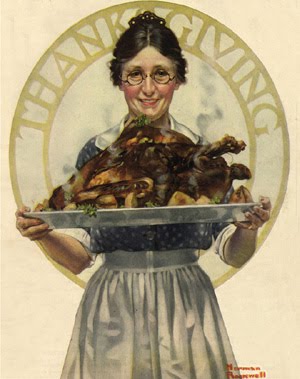
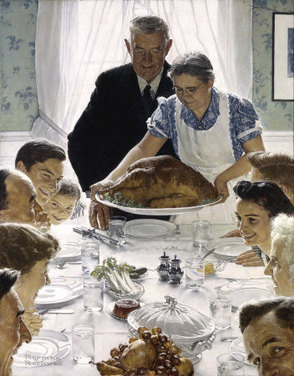
Norman Rockwell - Freedom from Want 1943
_ Norman Rockwell did not invent Thanksgiving. It may seem like it: if you've ever seen his iconic illustrations for the holiday, you know what Thanksgiving is supposed to be like. There they are (nobody I know but they must be out there) clean, scrubbed, and hungry, ready to dig into the enormous (authentic farm-raised) bird cooked by the loving grandmother, who brings it to the table, her (spotless) apron still in place, to place before the patriarch in his best (well-worn but neatly mended) suit so that he can offer a (modest but sincere) blessing.
It's easy, in our ironic, less modest and sincere age, to poke fun at this and other of Rockwell's images, to criticize - where are the people of color?, where are the vegetarian alternatives? - but Rockwell's Thanksgiving images, like much art, must be judged in context to appreciate. It's just as easy to miss the sly bits - the guy in the right corner peeking up at the viewer, breaking the illusion to ask, 'What do you think? Do you believe this?'
Picture
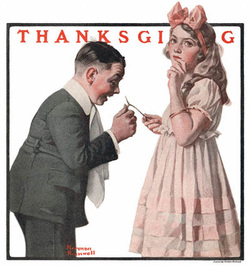
Norman Rockwell 1921 (The Country Gentleman)
_ An illustrator would not want to paint like that now, nor would there be a client for it -  but Rockwell was a master and there is much to admire. Look at the way he places arms and legs, how he uses white or negative space, the subtle play of gesture and angle. Ironically, however, his most famous 'Thanksgiving' image is, well, a bit ironic. It doesn't represent Thanksgiving - the title is Freedom from Want. This was the cover of the March 6, 1943 Saturday Evening Post, one of Rockwell's celebrated Four Freedom covers, created in the midst of a grueling war to remind America of it's good fortune. (The others are Freedom of Speech, Freedom of Worship, and Freedom from Fear) Some of those freedoms feel under fire these days, with the troubling news of economic and physical battering for too many Americans right now. It is a different time, and art always wears the cloak of its own time and place.
Picture
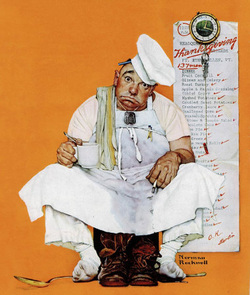
Norman Rockwell - Thanksgiving Day 1942 (Saturday Evening Post)
_ Rockwell did do other actual Thanksgiving illustrations, less sober and moralistic. He was a wonderful storyteller in the wholesome American folktale sort of mode, with a rollicking sense of visual humor that matched perfectly to the unironic, self-congratulatory mid 20th century, before hippies, rebels, and civil rights protesters started peeling back the veneer to reveal so much that needed to be admitted and addressed.
Picture
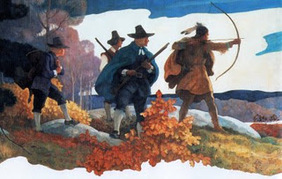
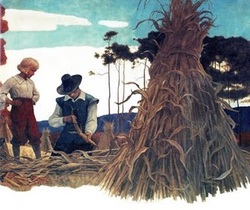
N.C. Wyeth - Pilgrim Mural 1940's
_ Rockwell follows in the footsteps of America's greatest illustrator, N. C. Wyeth, who is best known for his powerful Treasure Island series. He also did what could be classified as Thanksgiving illustrations; in 1940 he began a series of murals about the Pilgrims for the Metropolitan Life building in New York.
Picture
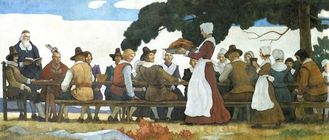
N.C. Wyeth - Pilgrim Mural 1940's
_ His take on this American tradition is colorful but somber, with careful attention to historical detail - gravitas fit to a darker time. You can find some of the Pilgrim illustrations gathered into a beautiful picture book, N. C. Wyeth's Pilgrims, by Robert San Souci, himself a prize-winning illustrator. An illustrator has to be a good storyteller - what sets both Wyeth and Rockwell at the top is their handling of story, color, form, detail - everything adding up to so much more than the whole.
Picture
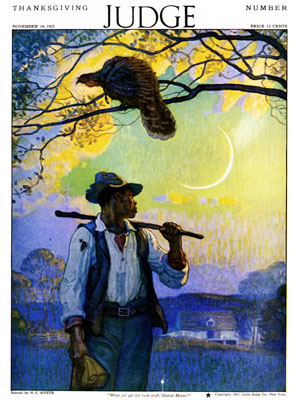
NC Wyeth - Pilgrim Mural 1940's
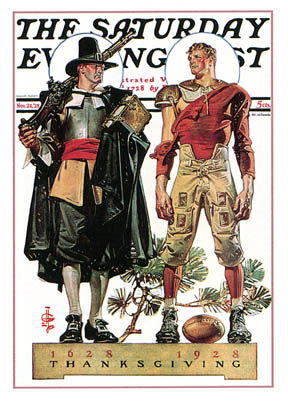
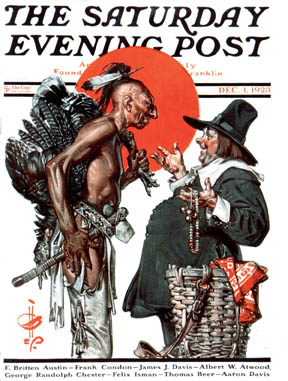
Happy Thanksgiving! What does your Thanksgiving look like?


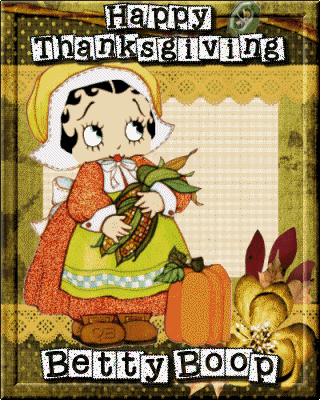
Here is a range of images of Thanksgiving images from the sublime to Betty Boop!
 
 
Picture
Work by Karen Akester
Scotland was in Philadelphia last weekend, in the person of 25 extraordinary artists at the Philadelphia Museum Craft Show. Each year the Craft show highlights the finest craft work of a particular country - this year it was Scotland, and what a rich showing these northern folk put on. I didn't get to talk to all of them, unfortunately, but I'll point out a few that stopped me in my tracks.


Picture
 I'm always on the lookout for drawing, even if I'm not aware of it, so Claire Heminsley's booth drew me in like a magnet. I felt like I'd found a long-lost sister when I saw her loose line drawings and saw her tribute to her artist dad who taught her about drawing (my father did the same - we used to go out sketching together.) Much of Claire's work involves fabric - printing her drawings on practical items like aprons or tea towels, as well as on multimedia work that combines stitching, typography, printing, and found objects. Her marriage of the ordinary with the ethereal adds up to a wonderful sense of serious fun. See more - and much better images - at  http://www.incahoots.org.uk/index.html  

Picture
Stacey Bentley photo by MMacGregor
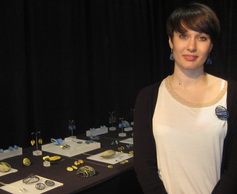
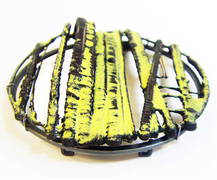
Across the aisle, Stacey Bentley was drawing too, this time in metal jewelry. Stacey is one of those lovely, well-groomed women whose appearance belies the tough reality of the process behind their work - industrial enamels, twisted and soldered metals, multiple firings - her work has a kind of brawny industrial feel in miniature, with an effect that mixes delicacy and grit. Stacey calls it an 'urban aesthetic' and cites influence from what she observes in her travels. See more at http://www.staceybentley.com/index.html. 

Picture
Brooch by Stacey Bentley
Picture
by Jilli Blackwood photo by MMacGregor
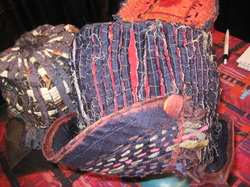
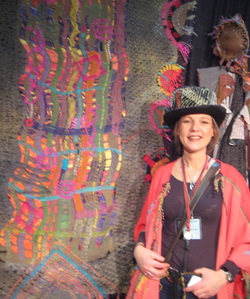
_ Fabric is the medium for Jilli Blackwood. Her extravaganzas, some wearable, some decorative, shout excitement across the room but also pull you in close to examine her marvelous, infinitely adventurous play with cloth, embroidery, stitching, color, and texture. Process and imagination for Jilli, as with most of these artists, are tightly interwoven. She talks of color and hand dying as the entry point for developing her ideas and bringing in the unique personality that marks each piece.

Picture
Jilli Blackwood photo by MMacGregor
_ She described one piece as based on elephants she observed while creating costumes for the Commonwealth Games in India - it made sense as she pointed out sinuous lines that recall an elephant's flexible trunk, and the grey green texture of cloth that stands for an elephant's tough hide, and then in, on, and around those concrete images she wove her magic to conjure up a whole visual narrative of association through stitch and color. See more at  http://www.jilliblackwood.com/index.html  

Picture
by Carla Edwards
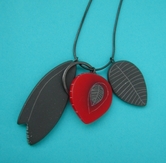
_ Carla Edwards resin jewelry matches Jilli's work for color but is a world apart in texture. Her softly bright pendants, earrings, and brooches, inspired by natural shapes and forms, have a smooth, inviting visual and tactile feel. See more athttp://www.carlaedwards.co.uk 

Picture
by Karen Akester photo by MMacGregor
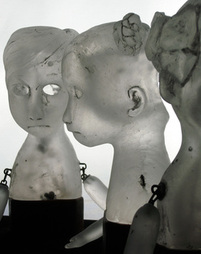
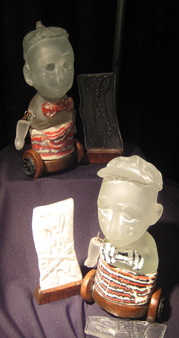
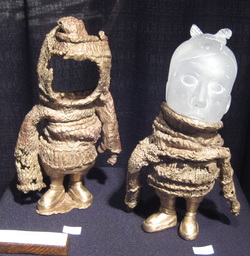
_ The haunting charm of Karen Akester's small evocative figures is still vivid in my mind - her work was one of the most memorable experiences of the entire show (which, of course, also included so much fabulous work by American artists from everywhere - see my posts from other years about this great Crafts Show.) Karen, educated at Edinburgh's School of the Arts and working there in one of several art communities supported with private and government funds (from what I heard from these artists, the US could learn a lot from Scotland about supporting the arts) was not only delightful to talk with, but an artist whose work rises to that rare place of brilliance in conception and craftsmanship.

Picture
Karen Akester photo by MMacGregor
_  She creates with glass and metal, sometimes together, sometimes separately, but her figures always add up to more than the sum of their parts. Using vintage photographs of schoolchildren as her starting point, she makes small standing figures, a bit woebegone and melancholy, that quietly spill out an intense sense of dark whimsical mystery. It's impossible not to want to know more - or to start telling yourself their stories, which are surely full of guilty mischief, punishments involving bed without supper - or worse. See more at http://www.karenakester.com/

_ If only my MacGregor ancestors had been better behaved in the 18th century - if they hadn't been run out of the country as outlaws I might still be there, working and hanging out with these warm, friendly, interesting, gifted artists. 

For more information about Scotland's Craft Artists and the artists who participated in the Philadelpjhia show go to http://www.craftscotland.org/about-us/our-work/PMA/

Which of these works and artists do you find most interesting - and why?
Leave a comment! 


Picture
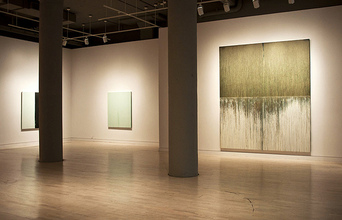
Pat Steir: Water and Sand at Lockes Gallery
_ I first became aware of Pat Steir when I assigned an Art in America article about her work to a student years ago. I can't remember what the student did with it, but Steir's graceful, mesmerizing work really stuck with me. I was happy, therefore, to find it close to home, in a fine exhibit currently at the Locks Gallery in Center City Philadelphia. The large color drenched canvases seem somehow made for this particular setting with its dark ceiling and columns; the fit of space and content has an organic, inevitable feeling that adds satisfaction to the experience of the show.

Picture
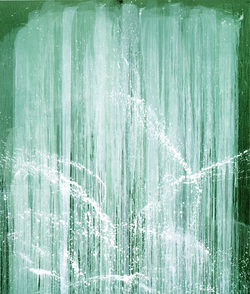
_ Any description of Steir's painting includes the word 'waterfall' - the pictures make the description self-explanatory. She treasures the happenstance of art-making, a value she credits in part to her friendship with John Cage, who introduced her to its potential. Steir's work testifies to her chronology - her Action Painting approach connects her not only to the ideas of Cage but also to older, but not distant contemporaries Joan Mitchell and Helen Frankenthaler. Color pours down her canvases in watery, nuanced sheets of layered hue, shade, and value: the action of the making continues in the finished work.

Picture
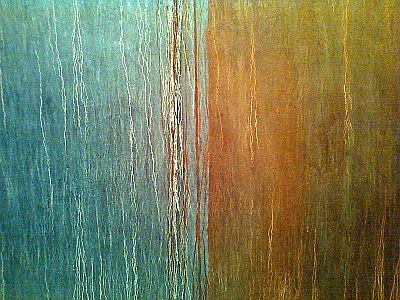
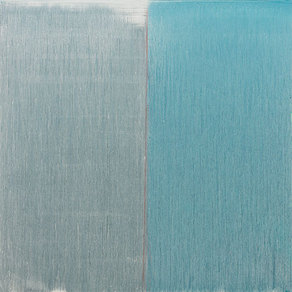
_ At a distance the canvases give off a rich, soothing rhythm, but up close the general blur defines into fine trails that mingle, divide, and pool together. There is also a strong link to Chinese landscape painting, mentioned in the press release for the show, manifested in a feeling of ethereal grandeur as well as the fine layering of organic strokes. Most of the works in the show are named for the pigments she used in creating them: naples yellow, paynes grey, indigo, a particular green or blue. Several include gold pigments.

Picture
White over Indigo, 2011 Lockes Gallery exhibit
_ A good part of the pleasure of the work, for me, was inspecting the surfaces at close range, finding the happy accidents that arise from Steir's process - rivulets of gold coursing through, over, and behind sheets of white, blue, green, leaving little nuggets at a crossroad where she made a divide, a buried color suddenly peeping through to make a quietly assertive statement.

Pat Steir: Water and Sand is at the Locks Gallery through November 26.

http://www.locksgallery.com/exhibits_works.php?eid=133


Picture
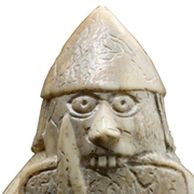
'Berserker' soldier from the Lewis Chessmen
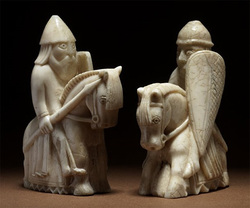
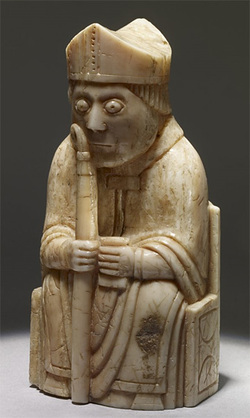
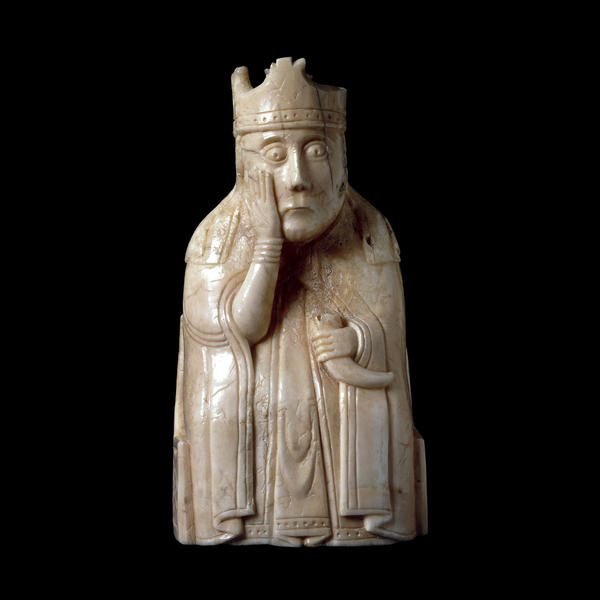
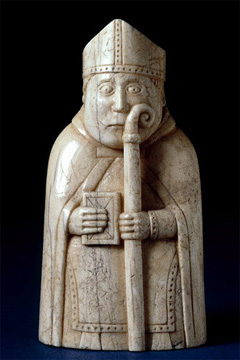
My favorite little men are coming to New York - The Game of Kings: Medieval Ivory Chessmen from the Isle of Lewis opens at the Cloisters on November 15. Bug-eyed Kings dismayed at the prospect of close and bloody combat, Queens holding worried faces, Soldiers so eager to begin that they bite their shields in anticipation, Bishops gripping their croziers, Horsemen hunched and ready: these little ivory creatures give us a world that faded long ago, though their iconic battle persists and endures in the game of chess.

Picture
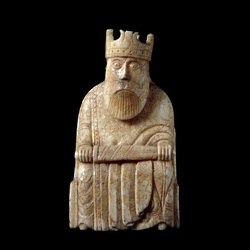
KIng from the Lewis Chessmen
It is a fact that these delicate but vigorously carved ivory creatures were found in 1831 on the Scottish Isle of Lewis. It's agreed that they date from around the 11th century (partly attested by the style of the Bishop's miter) but beyond that almost all is speculation. Are they Icelandic, or Norwegian, for whom were they created, by whom were they used? The pieces have so much personality; it's frustrating that they can't tell more of their story.

Picture
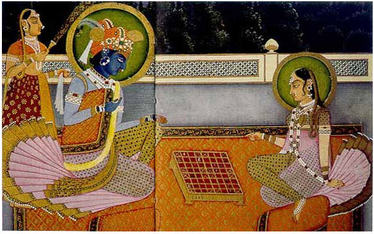
Krishna and Radha playing Chaturanga
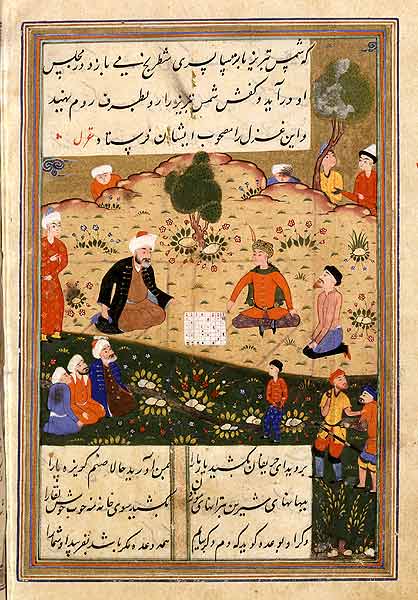
The game of chess predates these 'men', which are likely pieces from four sets - some are now in the National Museum of Scotland and some in the British Museum (which lent theirs for the show.) Chess began sometime around 600 in northern India or Afghanistan - the vocabulary of chess and the basic forms and rules come directly from those origins. Here  Krishna and his consort Radha play Chaturanga, the precursor to chess.

Picture
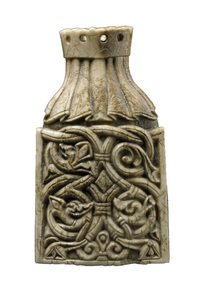
Back detail of a Queen from the Lewis Chessmen
Chess became very popular in aristocratic Europe during the 11th century - the quality of the Lewis Chess Set identifies the owners, whoever they were, as being of wealthy and privileged rank. Even the backs are carved, in the intricate woven patterns consistent with the time and place. Norse mythology is written in these pieces, particularly in the 'Berserkers' - those avid soldiers - Berserkers in the sagas were soldiers so frenzied by battle that they fought in a trance.

Picture
Knights from the Lewis Chessmen
The pieces are small, but larger than the ordinary chess 'men' of today's game - it is said that the board needed for a full game would have measured about 3 feet across - and that the board may have been red and white rather than black and white. Either color opposition makes symbolic sense: archetypal opposition can be seen as dark vs light, or as blood/passion red vs purity/innocence.

Picture
Bishop from the Lewis Chessmen
A drafty battle tent, a lofty hall in a great stone castle, a blustery cold wind flapping and wuthering, the light from a fire flickering over battle-worn hands, faces creased as they ponder their moves and shift these woeful, charming little creatures - the Lewis Chessmen tell us silently that they were there, even if they can't tell us exactly where.

Click these links to learn more about the exhibit and the Lewis Chessmen
http://www.nms.ac.uk/our_museums/national_museum/lewis_chessmen_unmasked/meet_the_chessmen.aspx

http://www.metmuseum.org/exhibitions/listings/2011/the-game-of-kings-medieval-ivory-chessmen-from-the-isle-of-lewis

Are You A Chess Player? Is it just a game for you or an iconic battle of life and death?