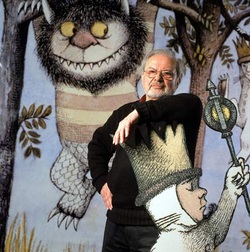
Maurice Sendak 1928-2012
Childhood was very good to Maurice Sendak - not his own so much, but the childhood he gave to others. His books opened up new worlds for children. Though it was sad to lose him last month, he left a great deal - great in all senses - not a bad way to go at 83. Many of the children that were his first audience are now grey-haired grandparents, but I’ll bet a little boy named Max, dressed in a wolf suit, still lives in their hearts.
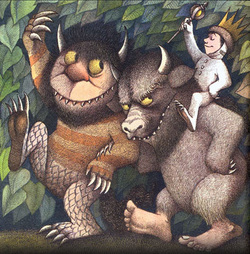
From Where the Wild Things Are 1963
Where the Wild Things Are came out in 1963, the same year Sylvia Plath’s The Bell Jar and Betty Friedan’s The Feminine Mystique were published. As much as the others Where the Wild Things Are caused an uproar – it was a time when the future was challenging an outmoded mindset with a dose of hard reality. Librarians and teachers vilified Sendak’s book, calling it dark and too frightening for children, but the kids knew better, recognizing in the simple story of a child struggling to control his own wild impulses the basic truth that childhood is, in fact, darker and more frightening than adults own up to once they’re past it.
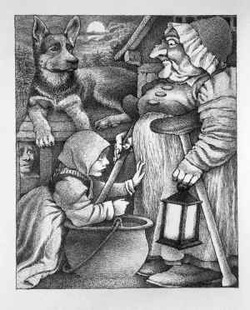
From The Juniper Tree 1974
Sendak had a gift for taking childhood seriously - I’d call it his greatest strength. Too many well-intentioned kid’s book authors think children and their state of being are ‘cute.’ Sendak never made that mistake. His own well-documented childhood in a family of Holocaust survivors (along with ever-present specters of his family’s victims) gave him a front row seat on dark and frightening, but combined with the ebullient humor and spirit ever present in his work, his was a powerful, compelling vision.
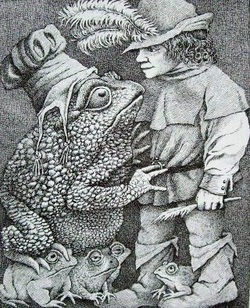
From the Juniper Tree 1974
What isn’t always mentioned with Maurice Sendak is how steeped he was in the traditions of children’s illustrations. He was an original with a beautifully unique voice, but like all great artists, he had a profound knowledge of and respect for his craft and his predecessors. In The Juniper Tree, a collection of Grimm’s Tales (1974), Sendak went directly to the source with a meticulous technique based on European, especially German, engraving techniques. The Juniper Tree is a tour de force of children’s illustration, very different from the bolder linear drawings in Where the Wild Things Are and In the Night Kitchen, but with Sendak’s signature faces, expressions, and gestures - deeply thought, a bit troubling, and humorous, all at the same moment.
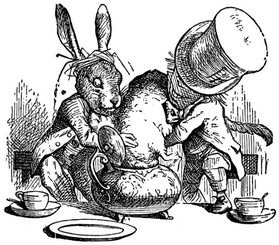
John Tenniel Alice's Adventures in Wonderland 1865
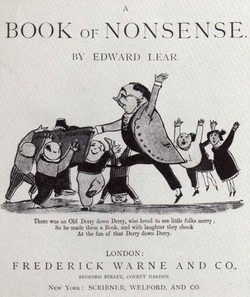
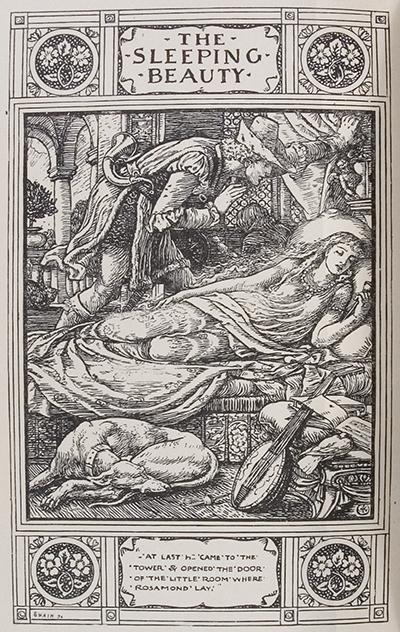
The German connection in Sendak’s work has been clearly noted, but there is plenty more from the broad field of fine children’s illustration. Beatrix Potter’s anthropomorphic animals, full of charm but no squishy sentimentality, John Tenniel’s seriously, delightfully kooky world in Alice in Wonderland, Walter Crane’s gorgeous command of line and composition, Edward Lear’s goofy playful illustrated verses – and plenty more, including Fritz Eichenberg, an older contemporary.
| 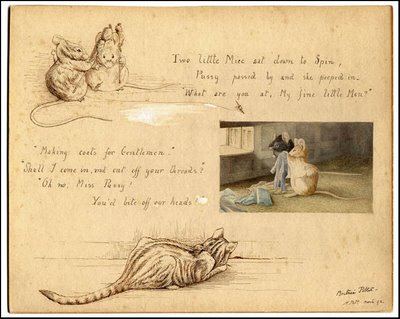 Beatrix Potter - diary page 1880's |
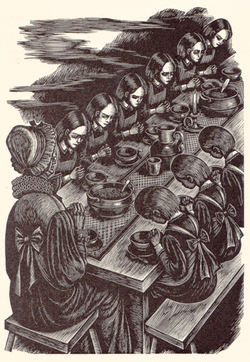
Fritz Eichenberg Jane Eyre 1943
As a young illustrator Sendak must have been well aware of Eichenberg, who fled Germany ahead of the Nazi’s in the 30’s and built a significant career as a teacher and illustrator in New York. Eichenberg’s dark brooding wood engravings for Jane Eyre and Wuthering Heights are among my most enduring childhood memories - when I encountered the editions as an adult I felt the shock of recognition of a long-lost friend. Sendak and Eichenberg were, in some senses, kindred souls, each a master with an affinity for craft and fine careful work in illustration, divided and united by a common history.
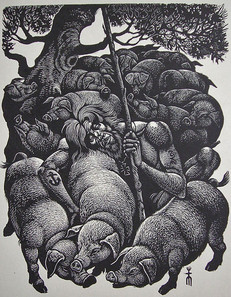 The Prodigal Son 1967 | 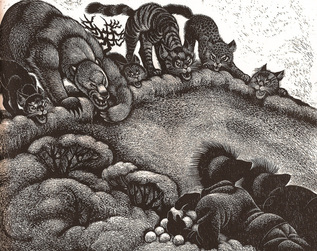 Child's Christmas in Wales 1969 |
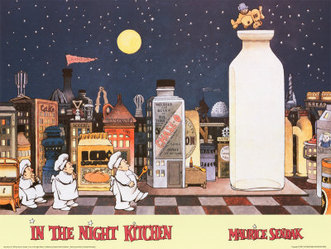
Maurice Sendak In the Night Kitchen 1970
Sendak’s path led him to lighter ground where his sense of play had full rein, not only in books but in theatre and opera design. Spend some time with Where the Wild Things Are and In the Night Kitchen and you’ll see that Sendak was always a set designer – his books unfold with all the drama of a well-made play. He never shortchanged children - he gave them the best, and his best was magnificent. The work of a lifetime, and lifetimes before him, is in every line he drew.
An exhibit of Sendak's work has just opened at the Rosenbach Museum in Philadelphia.
Maurice Sendak: A Legacy continues through May 26, 2013
https://www.rosenbach.org/learn/exhibitions/maurice-sendak-legacy
An exhibit of Sendak's work has just opened at the Rosenbach Museum in Philadelphia.
Maurice Sendak: A Legacy continues through May 26, 2013
https://www.rosenbach.org/learn/exhibitions/maurice-sendak-legacy



 RSS Feed